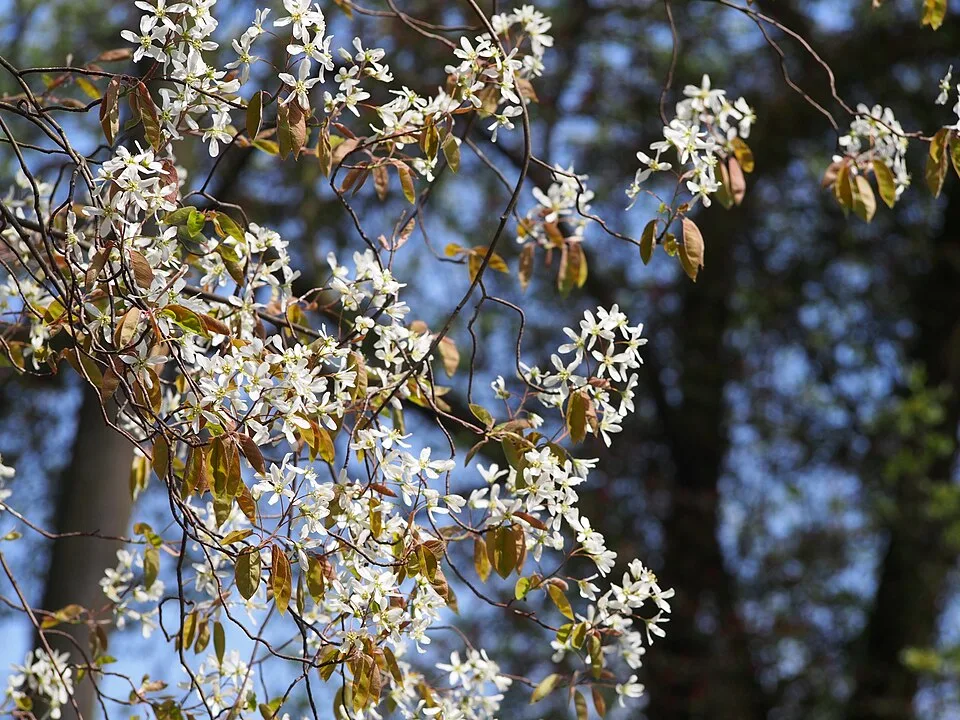
Amelanchier lamarckii in spring flower. This is a planting example, not a pollen-free tree.
Photo credit & licence
Photo: Agnieszka Kwiecień, Nova. CC BY-SA 4.0. Original photograph on Wikimedia Commons. Resized and converted to WebP; any card crop uses the same licence. Educational illustration; plants and cultivars vary.
THE SHORT VERSION
Start with these useful points
What does “pollen-free” really mean?
Most flowering trees produce pollen. In species with separate male and female plants, a correctly identified female plant does not produce male pollen; this does not remove pollen arriving from elsewhere.
Avoid assuming a plant is suitable because its pollen is less readily carried by wind: a flowering canopy directly above a seat can still shed pollen nearby.
Most flowering trees produce pollen. In species with separate male and female plants, a correctly identified female plant does not produce male pollen; this does not remove pollen arriving from elsewhere. A tree sold as fruitless is not automatically pollen-free. Ask for the botanical name, cultivar and verified sex where relevant rather than relying on a general marketing label.
Think about how pollen travels
A practical starting point for discussing plant choices
Plant group or label
What to check
Wind-pollinated trees, including birch, alder and hazel
They can release airborne pollen; consider your known sensitivities
Insect-pollinated flowering plants
Their pollen is generally heavier and less readily airborne, but exposure can still matter
Verified female plants of separately sexed species
Confirm sex, mature size and suitability; nearby plants may still contribute pollen
“Fruitless”, “low-allergen” or “sterile” labels
Ask what exactly is absent and whether pollen production has been verified
Design the seating area as well as the planting
Avoid assuming a plant is suitable because its pollen is less readily carried by wind: a flowering canopy directly above a seat can still shed pollen nearby. Check fragrance sensitivity too. Choose exact species around your own triggers and keep a record of what flowers when. Lawn and ornamental grass pollen may also matter, so reviewing only trees leaves part of the garden unexamined.
Use a careful shortlist rather than a guarantee
First shortlist plants that suit the garden’s soil, light and mature space. Then check their pollination characteristics with a reliable nursery and compare them with your known sensitivities. A beautiful small tree and a lower-pollen choice are separate questions. Our small-tree guide is a size and design guide, not a list of allergy-safe trees. No garden plant list can guarantee a symptom-free garden.
Other material in the garden can matter
Pollen is not the only possible trigger: decaying leaves and compost can contain moulds, and some plants can irritate skin or cause problems through strong fragrance. Use local pollen information to plan time outdoors. Persistent symptoms or uncertainty about your triggers need individual advice from a healthcare professional; plant selection is not a treatment.